
Unable to find what you're searching for?
We're here to help you find itDesign mechanical systems using MSC Adams, simulate dynamic motion with Adams/View, and analyze joint forces with Adams/Solver. Koenig’s officially credentialed trainers deliver hands-on labs and real-world projects to prepare you for Multi-Body Dynamics certification.


500K+ certified professionals



























Explore Multi-Body Dynamics (MBD) certification and training courses — delivered live by certified instructors.
Multi-Body Dynamics (MBD) is a simulation technology developed by MathWorks within the Simscape environment to model and analyze the motion and forces of interconnected mechanical systems, such as robots, vehicle suspensions, and aircraft landing gear. It enables engineers to create 3D mechanical models using physical components and solve the equations of motion for system-level performance evaluation, forming a core part of the Simulink-based physical modeling ecosystem. The technology includes Simscape Multibody for constructing rigid and flexible bodies using CAD data or parameterized geometry, Joints and Constraints to define degrees of freedom and kinematic relationships, Forces and Torques for actuation and load modeling, Sensors to measure motion and reaction forces, and Flexible Bodies for simulating deformable components using finite element methods, all integrated within the broader Simscape family for multidomain physical system simulation. Multi-Body Dynamics is for mechanical engineers, robotics developers, and automotive designers who need to accurately simulate complex mechanical assemblies, optimize system performance, and validate control strategies before physical prototyping, enabling precise analysis of dynamic interactions between interconnected components.
Rigid Body Kinematics
Describe position, orientation and motion of rigid bodies in 3D space
Newtonian Mechanics
Apply force and moment equilibrium to dynamic systems of rigid bodies
Vector and Matrix Algebra
Use tensor and matrix operations for kinematic and dynamic formulations
Kinematic Joints
Model constraints and degrees of freedom using standard joint types
Differential Equations
Formulate and solve ODEs and DAEs arising in dynamic systems
Numerical Integration
Implement algorithms for time integration of multibody system dynamics
The building blocks every Multi-Body Dynamics (MBD) solution is made of
See what your official Multi-Body Dynamics (MBD) certification looks like. Download a sample — then let our advisors map the fastest path to earning the real one.
 CSWA-SimulationCertified SOLIDWORKS Associate - Simulation
CSWP-SimulationCertified SOLIDWORKS Professional - Simulation
CSWACertified SOLIDWORKS Associate
CSWPCertified SOLIDWORKS Professional
CSWECertified SOLIDWORKS Expert
CSWE-SimulationCertified SOLIDWORKS Expert - Simulation
Official credential badges — shareable on LinkedIn
CSWA-SimulationCertified SOLIDWORKS Associate - Simulation
CSWP-SimulationCertified SOLIDWORKS Professional - Simulation
CSWACertified SOLIDWORKS Associate
CSWPCertified SOLIDWORKS Professional
CSWECertified SOLIDWORKS Expert
CSWE-SimulationCertified SOLIDWORKS Expert - Simulation
Official credential badges — shareable on LinkedIn
Four formats. One quality standard. Every option comes with the same expert instructors, official courseware, and money-back guarantee.
Every factor that determines whether you actually pass your Multi-Body Dynamics (MBD) exam — rated across every training format available.
| Criteria | Koenig | ALP Provider | Legacy Provider | Self-Paced Platform | Free Platform |
|---|---|---|---|---|---|
| Trainer Quality & Credentials | |||||
| Authorized MSC Trainer | |||||
| Live Instructor-Led Delivery | Partial | ||||
| 1-on-1 Private Training | |||||
| MSC Software Authorization | |||||
| Official MSC ALP Status | |||||
| Official MSC Courseware | Partial | Partial | |||
| Flexibility & Access | |||||
| Any-Day/Flexi Start | |||||
| On-Site Delivery | Partial | ||||
| Global Delivery Reach | Partial | ||||
| Results & Trust | |||||
| Entry Price (Fundamentals) | ~$745 (Includes lab access) | ~$1,500+ (Excludes exam fees) | ~$1,200 (Excludes exam fees) | $15-30/mo (No exam/software) | Free (No certification/support) |
| Verified Learner Reviews | 18,400+ · 4.9★ | Limited | Limited | 10,000+ · 4.5★ | 5,000+ · 4.7★ |
Data sourced from public pricing pages and review platforms. Accurate as of March 2026. Partial = available in select regions only.
Verified reviews from learners certified on Azure, AI, Security, and more.
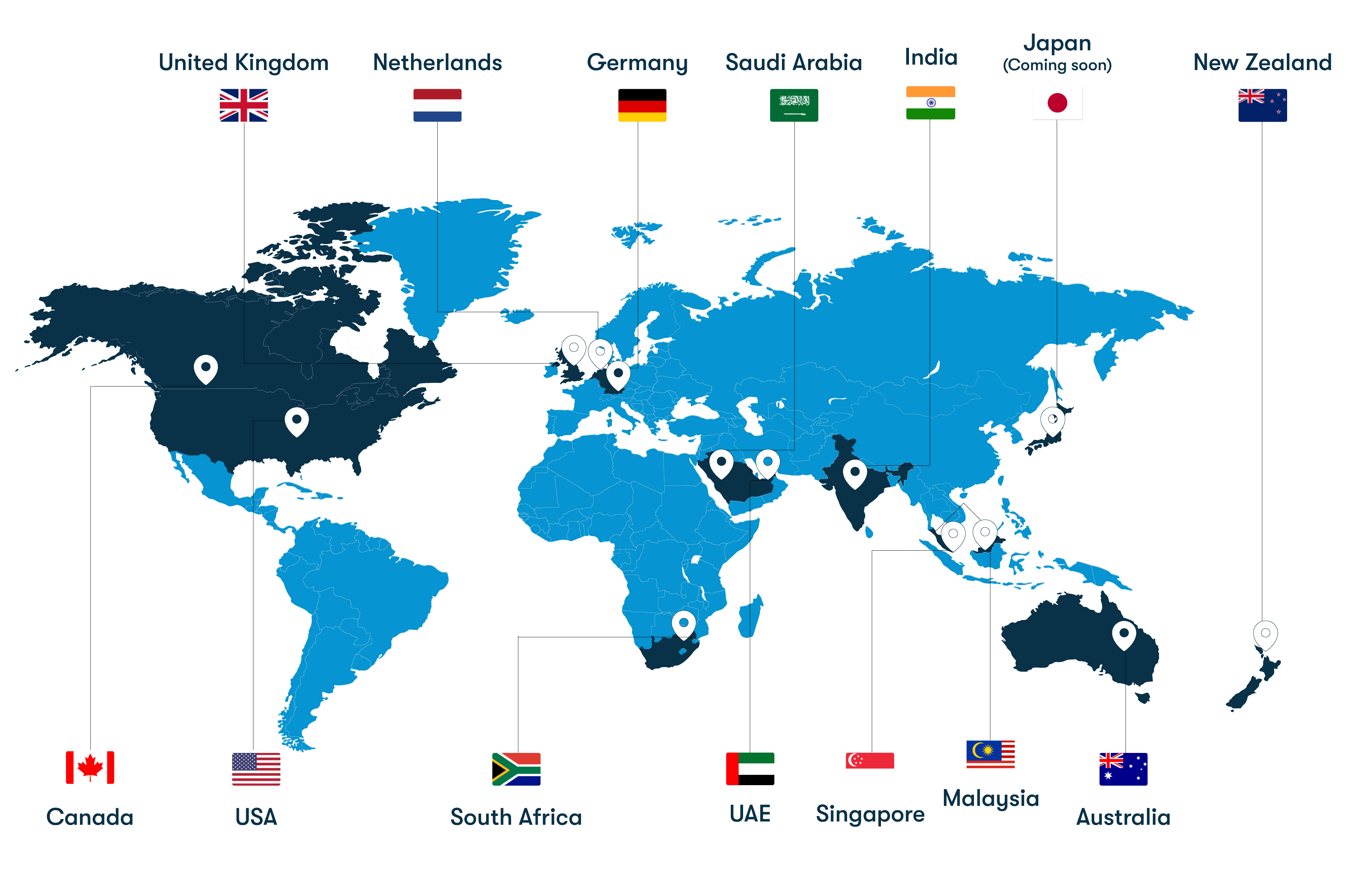
From our headquarters in India to training centers across UAE, Iraq, Saudi Arabia, UK, USA, Singapore, Australia, and more — Koenig delivers Microsoft certification training in 50+ countries.