
Unable to find what you're searching for?
We're here to help you find itMaster VLAN design, configuration, and security using IEEE 802.1Q trunking and inter-VLAN routing. Koenig prepares you for the CCNA exam with expert-led, hands-on training.


500K+ certified professionals



























Explore VLAN certification and training courses — delivered live by certified instructors.
A Virtual Local Area Network (VLAN) is a logical network segmentation technology standardized by IEEE 802.1Q that partitions a physical LAN into multiple broadcast domains to improve security, performance, and network management. It operates at Layer 2 of the OSI model and enables devices to be grouped by function or policy rather than physical location, forming isolated communication domains across switches. Key components include Access interfaces, which connect end devices and assign frames to a single VLAN; Trunk interfaces, which carry traffic for multiple VLANs between switches or routers using IEEE 802.1Q tagging; Hybrid interfaces, which flexibly handle both tagged and untagged traffic for complex deployment scenarios; and QinQ interfaces, which provide stacked VLAN tagging for service providers by encapsulating customer VLANs within a second VLAN tag. Network administrators, switch operators, and infrastructure engineers use VLANs to segment traffic, enforce security policies, and simplify moves, adds, and changes in enterprise and service provider environments.
Layer 2 Fundamentals
Explain Ethernet switching, MAC addresses and broadcast domains
Switch Port Roles
Configure access ports and trunk ports using IEEE 802.1Q
VLAN Identification
Assign and verify VLAN IDs 1–4094 on switch interfaces
Trunking Protocol
Implement DTP or static trunking on Cisco switch links
Spanning Tree
Understand PVST+ operation per VLAN to prevent loops
Inter-VLAN Routing
Describe need for Layer 3 routing between VLANs
The building blocks every VLAN solution is made of
See what your official VLAN certification looks like. Download a sample — then let our advisors map the fastest path to earning the real one.
 200-301 CCNACisco Certified Network Associate
350-401 ENCORImplementing Cisco Enterprise Network Core Technologies
300-410 ENARSIImplementing Cisco Enterprise Advanced Routing and Services
300-415 ENSDWIImplementing Cisco Catalyst SD-WAN Solutions
300-420 ENSLDDesigning Cisco Enterprise Networks
CCIE Enterprise Infrastructure lab examCCIE Enterprise Infrastructure lab exam
Official credential badges — shareable on LinkedIn
200-301 CCNACisco Certified Network Associate
350-401 ENCORImplementing Cisco Enterprise Network Core Technologies
300-410 ENARSIImplementing Cisco Enterprise Advanced Routing and Services
300-415 ENSDWIImplementing Cisco Catalyst SD-WAN Solutions
300-420 ENSLDDesigning Cisco Enterprise Networks
CCIE Enterprise Infrastructure lab examCCIE Enterprise Infrastructure lab exam
Official credential badges — shareable on LinkedIn

Four formats. One quality standard. Every option comes with the same expert instructors, official courseware, and money-back guarantee.
Every factor that determines whether you actually pass your VLAN exam — rated across every training format available.
| Criteria | Koenig | ALP Provider | Legacy Provider | Self-Paced Platform | Free Platform | Note |
|---|---|---|---|---|---|---|
| Trainer Expertise & Quality | ||||||
| CCSI-Certified Trainers | ✘ | ✘ | ✘ | — | ||
| Live Instructor-Led VLAN Training | ✘ | ✘ | — | |||
| Hands-on VLAN Configuration & Trunking Labs | Partial | ✘ | — | |||
| 1-on-1 Personalized Coaching | Partial | ✘ | ✘ | ✘ | — | |
| Cisco Authorization Standards | ||||||
| Official Cisco ALP Status | ✘ | ✘ | — | |||
| Official Cisco Courseware | ✘ | ✘ | — | |||
| Cisco Learning Credits Accepted | ✘ | ✘ | — | |||
| Delivery Flexibility & Access | ||||||
| Any-Day/Flexi Start Dates | Partial | ✘ | — | |||
| On-Site/Fly-Me Trainer Options | Partial | ✘ | ✘ | ✘ | — | |
| Global Delivery Capabilities | ✘ | Partial | — | |||
| Results & Trust Metrics | ||||||
| Official Pass Rate Disclosure | N/A | N/A | N/A | N/A | N/A | Cisco does not publish official pass rates |
| CCNA Training Entry Price | ~$745 · best value | ~$1,500+ | ~$1,200 | $15-30/mo | Free | — |
| Verified Student Reviews | 18,400+ · 4.9★ | 100,000+ · 4.5★ | Limited | Limited | N/A | — |
Data sourced from public pricing pages and review platforms. Accurate as of March 2026. Partial = available in select regions only.
Verified reviews from learners certified on Azure, AI, Security, and more.
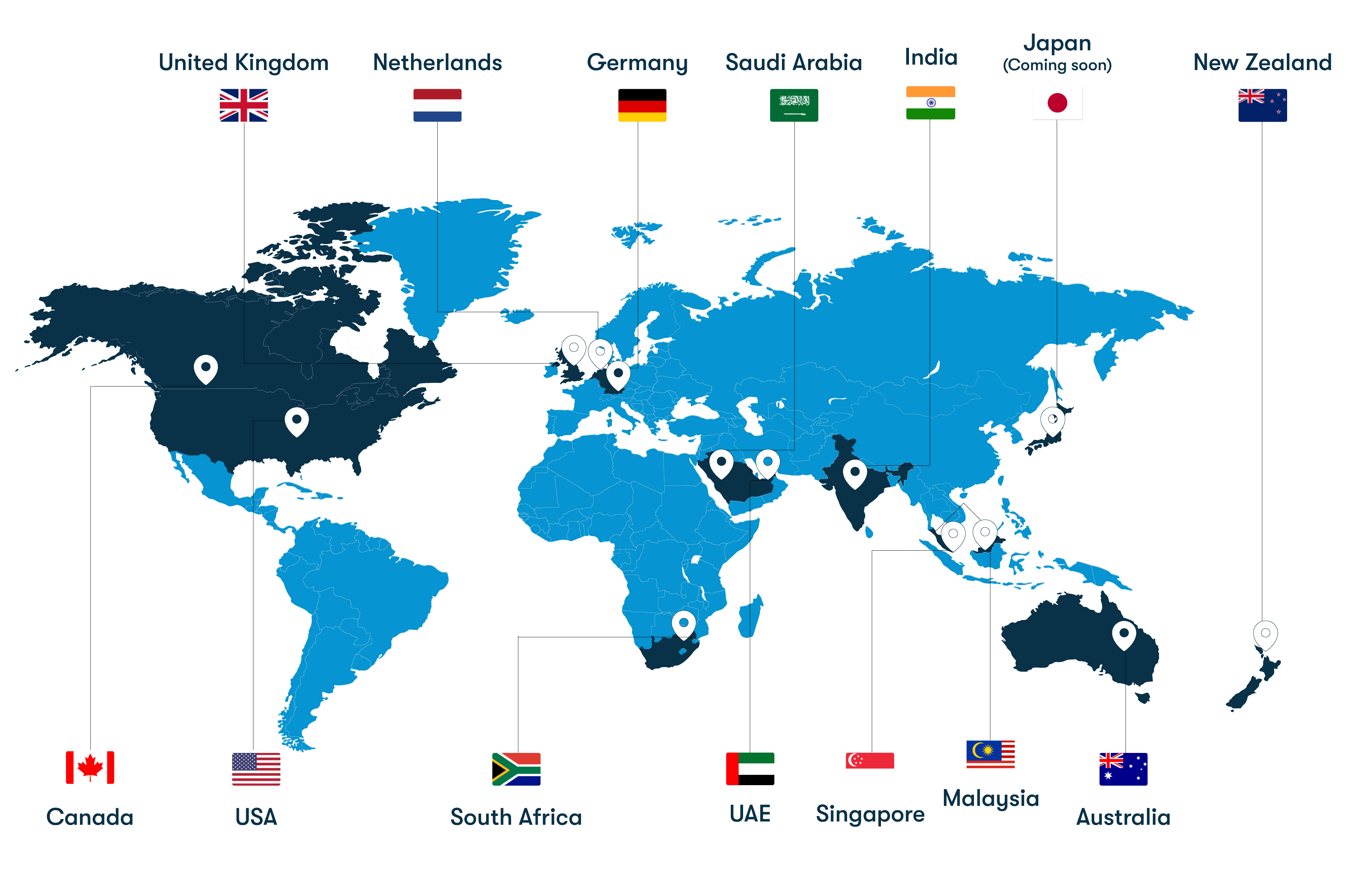
From our headquarters in India to training centers across UAE, Iraq, Saudi Arabia, UK, USA, Singapore, Australia, and more — Koenig delivers Microsoft certification training in 50+ countries.