
Unable to find what you're searching for?
We're here to help you find itMaster data analysis, control systems, and AI deployment with MATLAB. Koenig provides expert-led training and hands-on projects to prepare you for the official MathWorks Certified MATLAB Associate certification.


500K+ certified professionals
























Explore MATLAB certification and training courses — delivered live by certified instructors.
MATLAB is a programming and numeric computing platform developed by MathWorks for engineers and scientists, designed to solve complex computational problems in engineering, science, and mathematics. It serves as the foundational environment for algorithm development, data analysis, visualization, and simulation, and is tightly integrated with Simulink for model-based design workflows. Key components include MATLAB for algorithm development and interactive computing, Simulink for multidomain system simulation and automatic code generation, MATLAB Toolboxes for specialized tasks like signal processing and machine learning, MATLAB Copilot for AI-assisted coding, and MATLAB Compiler for deploying algorithms into production environments. MATLAB is for engineers, scientists, and researchers who need a powerful, integrated environment to analyze data, develop algorithms, and model complex systems across fields such as robotics, control systems, wireless communications, and computational finance.
MATLAB Fundamentals
Master array manipulation, script development, and data visualization within the MATLAB Desktop Environment.
Programming Basics
Implement efficient control flow and debugging techniques using MATLAB vectorization and indexing.
Data Types
Perform complex computations on matrices, tables, and time series data using native MATLAB structures.
Toolbox Access
Navigate and apply core MATLAB toolboxes to solve domain-specific engineering and scientific problems.
Mathematical Proficiency
Demonstrate foundational knowledge in Linear Algebra and Calculus essential for MATLAB computation.
Development Environment
Utilize MATLAB R2023b or later via the installed desktop interface or MATLAB Online.
The building blocks every MATLAB solution is made of
See what your official MATLAB certification looks like. Download a sample — then let our advisors map the fastest path to earning the real one.
 Certified MATLAB AssociateCertified MATLAB Associate
Certified MATLAB ProfessionalCertified MATLAB Professional
Official credential badges — shareable on LinkedIn
Certified MATLAB AssociateCertified MATLAB Associate
Certified MATLAB ProfessionalCertified MATLAB Professional
Official credential badges — shareable on LinkedIn
Four formats. One quality standard. Every option comes with the same expert instructors, official courseware, and money-back guarantee.
Every factor that determines whether you actually pass your MATLAB exam — rated across every training format available.
| Criteria | Koenig | ALP Provider | Legacy Provider | Self-Paced Platform | Free Platform |
|---|---|---|---|---|---|
| Trainer Quality & Credentials | |||||
| MathWorks Certified Associate/Professional Trainers | ✘ | ✘ | ✘ | ||
| Live Instructor-Led | Partial | ✘ | ✘ | ||
| 1-on-1 Private Training | ✘ | ✘ | ✘ | ✘ | |
| MathWorks Authorization | |||||
| Official MathWorks Partner | ✘ | ✘ | ✘ | ||
| Official MathWorks Courseware | ✘ | ✘ | |||
| MathWorks Training Credits Accepted | ✘ | ✘ | ✘ | ||
| Flexibility & Access | |||||
| Any-Day/Flexi Start | ✘ | ✘ | |||
| On-Site/Fly-Me-Trainer | ✘ | Partial | ✘ | ✘ | |
| Global Delivery Reach | Partial | Partial | |||
| Results & Trust | |||||
| Exam Pass Rate | ✘ | ✘ | ✘ | ✘ | |
| Entry Price (Est. for 4-5 day training) | ~$745 | ~$1,500+ | ~$1,200 | $15-30/mo | Free |
| Verified Learner Reviews | 18,400+ · 4.9★ | Limited | Limited | N/A | N/A |
Data sourced from public pricing pages and review platforms. Accurate as of March 2026. Partial = available in select regions only.
Verified reviews from learners certified on Azure, AI, Security, and more.
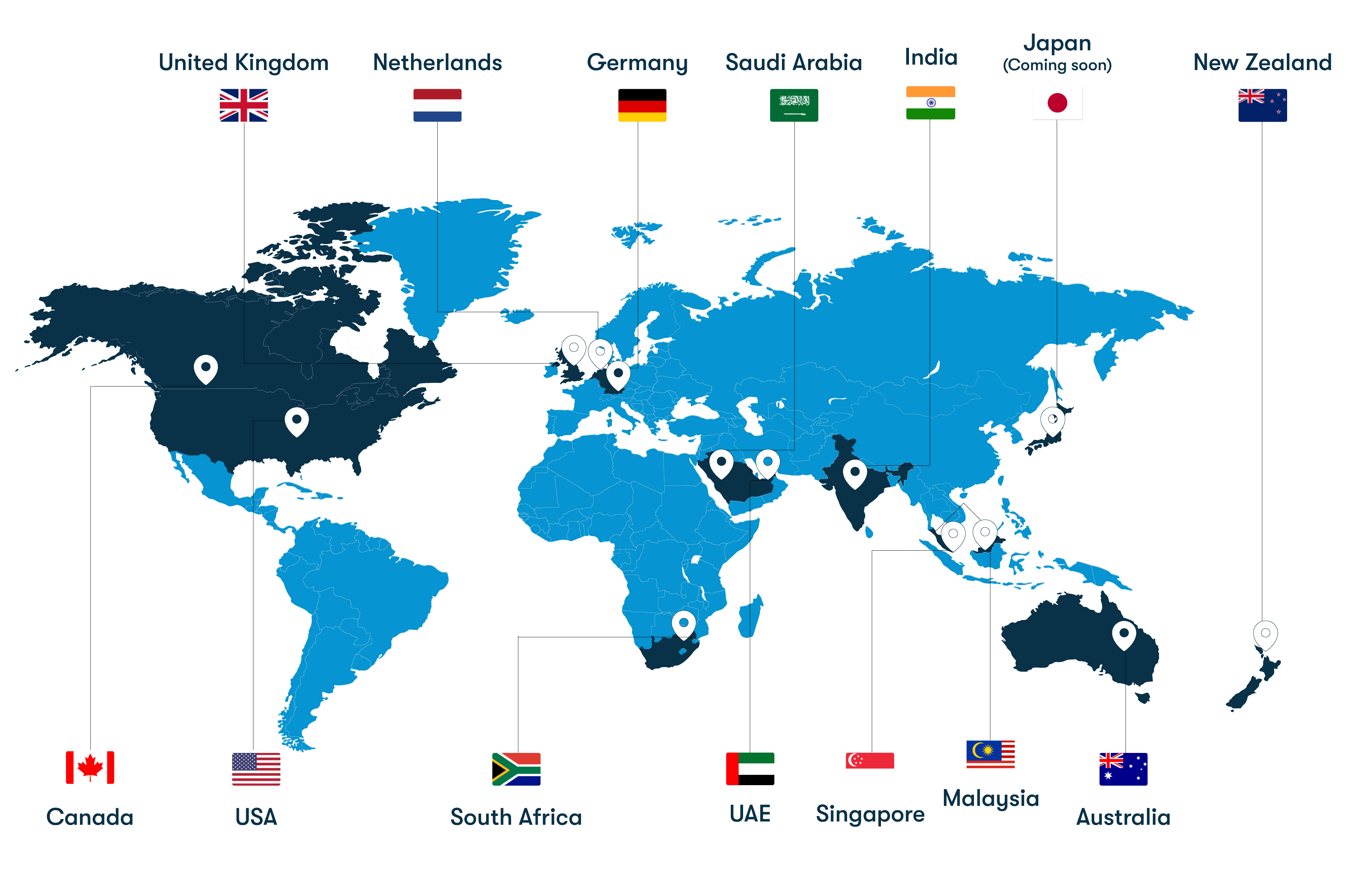
From our headquarters in India to training centers across UAE, Iraq, Saudi Arabia, UK, USA, Singapore, Australia, and more — Koenig delivers Microsoft certification training in 50+ countries.