
Unable to find what you're searching for?
We're here to help you find itKoenig Electrical Engineering provides expert training in RLC networks, power systems, and transformers. Master core concepts through hands-on labs aligned with FE Electrical and Computer exam standards.


500K+ certified professionals



























Explore Electrical Engineering certification and training courses — delivered live by certified instructors.
Electrical Engineering is a core engineering discipline focused on the study, design, and application of systems that generate, transmit, convert, and process electrical energy and signals. It addresses challenges across power generation, electronics, signal processing, and control systems, forming the foundation for technologies such as the electric grid, wireless communication, and digital computing. The field integrates principles from physics, mathematics, and materials science, guided by standards from organizations like IEEE and IEC. Key components include Power Engineering, which covers the design of generators, transformers, transmission lines, and protective relay systems; Electronics Engineering, focusing on analog and digital circuits, semiconductors, and integrated circuit design; Signal Processing, applying mathematical methods to extract and compress information from signals; Electromagnetics, dealing with field propagation, antenna design, and electromagnetic compatibility; and Control Engineering, which develops feedback systems to regulate dynamic processes in industrial and automated environments. Electrical Engineering is for engineers, researchers, and technical professionals working in power systems, telecommunications, automotive, aerospace, consumer electronics, and industrial automation who require a deep understanding of electrical systems to design, analyze, and maintain technology critical to modern infrastructure and innovation.
Circuit Fundamentals
Apply Ohm's law, Kirchhoff's laws and network theorems to analyze resistive circuits
Signal Processing
Analyze continuous and discrete signals using Fourier and Laplace transforms
System Dynamics
Model and solve linear time-invariant systems using differential equations and phasors
Complex Analysis
Perform operations with complex numbers and apply them in AC circuit analysis
Linear Algebra
Solve systems of linear equations and apply matrix operations in circuit modeling
Electronic Components
Identify and characterize passive and active components in analog and digital circuits
The building blocks every Electrical Engineering solution is made of
See what your official Electrical Engineering certification looks like. Download a sample — then let our advisors map the fastest path to earning the real one.
 NETA-L1NETA Level 1 Electrical Testing Technician
NETA-L2NETA Level 2 Electrical Testing Technician
NETA-L3NETA Level 3 Electrical Testing Technician
NETA-L4NETA Level 4 Electrical Testing Technician
PE-EEProfessional Engineer (PE) in Electrical Engineering (NSPE)
CESWCertified Electrical Safety Worker (NFPA/OSHA Standards)
Official credential badges — shareable on LinkedIn
NETA-L1NETA Level 1 Electrical Testing Technician
NETA-L2NETA Level 2 Electrical Testing Technician
NETA-L3NETA Level 3 Electrical Testing Technician
NETA-L4NETA Level 4 Electrical Testing Technician
PE-EEProfessional Engineer (PE) in Electrical Engineering (NSPE)
CESWCertified Electrical Safety Worker (NFPA/OSHA Standards)
Official credential badges — shareable on LinkedIn

Four formats. One quality standard. Every option comes with the same expert instructors, official courseware, and money-back guarantee.
Every factor that determines whether you actually pass your Electrical Engineering exam — rated across every training format available.
| Criteria | Koenig | Free Platform | Note | Self-Paced Platform | ALP Provider | Legacy Provider |
|---|---|---|---|---|---|---|
| Pedagogical Approach | ||||||
| Curriculum Depth | Theory-focused | Introductory | Reflects depth of Electrical Engineering principles | Conceptual | Balanced | Academic |
| Project-Based Learning | Limited | Minimal | Hands-on application of theory | Low | High | Moderate |
| ABET Alignment | Varies | Alignment with professional engineering standards | Low | High | High | |
| Technical Infrastructure | ||||||
| Lab Access | Virtual | Access to hardware and instrumentation | Physical/Remote | Physical | ||
| Software Proficiency (MATLAB/PSpice) | Basic | Limited | Training in industry-standard simulation tools | Basic | Advanced | Intermediate |
| Design Tooling (AutoCAD/Altium) | Introductory | Exposure to CAD/EDA design environments | Conceptual | Applied | Applied | |
| Career Outcomes | ||||||
| Industry Readiness | Moderate | Low | Preparation for engineering roles | Low | High | High |
| Certification/Credentialing | Certificate | Formal recognition of Electrical Engineering skills | Professional | Degree/Diploma | ||
| Mentorship Support | Instructor-led | Community-based | Level of expert guidance provided | Peer/Expert | Academic | |
| Flexibility | ||||||
| Schedule | Fixed | Flexible | Time commitment for Electrical Engineering study | Flexible | Hybrid | Fixed |
| Pacing | Structured | Self-directed | Control over learning velocity | Self-directed | Structured | Structured |
| Accessibility | Global | Global | Ease of enrollment and access | Global | Regional | Institutional |
Data sourced from public pricing pages and review platforms. Accurate as of March 2026. Partial = available in select regions only.
Verified reviews from learners certified on Azure, AI, Security, and more.
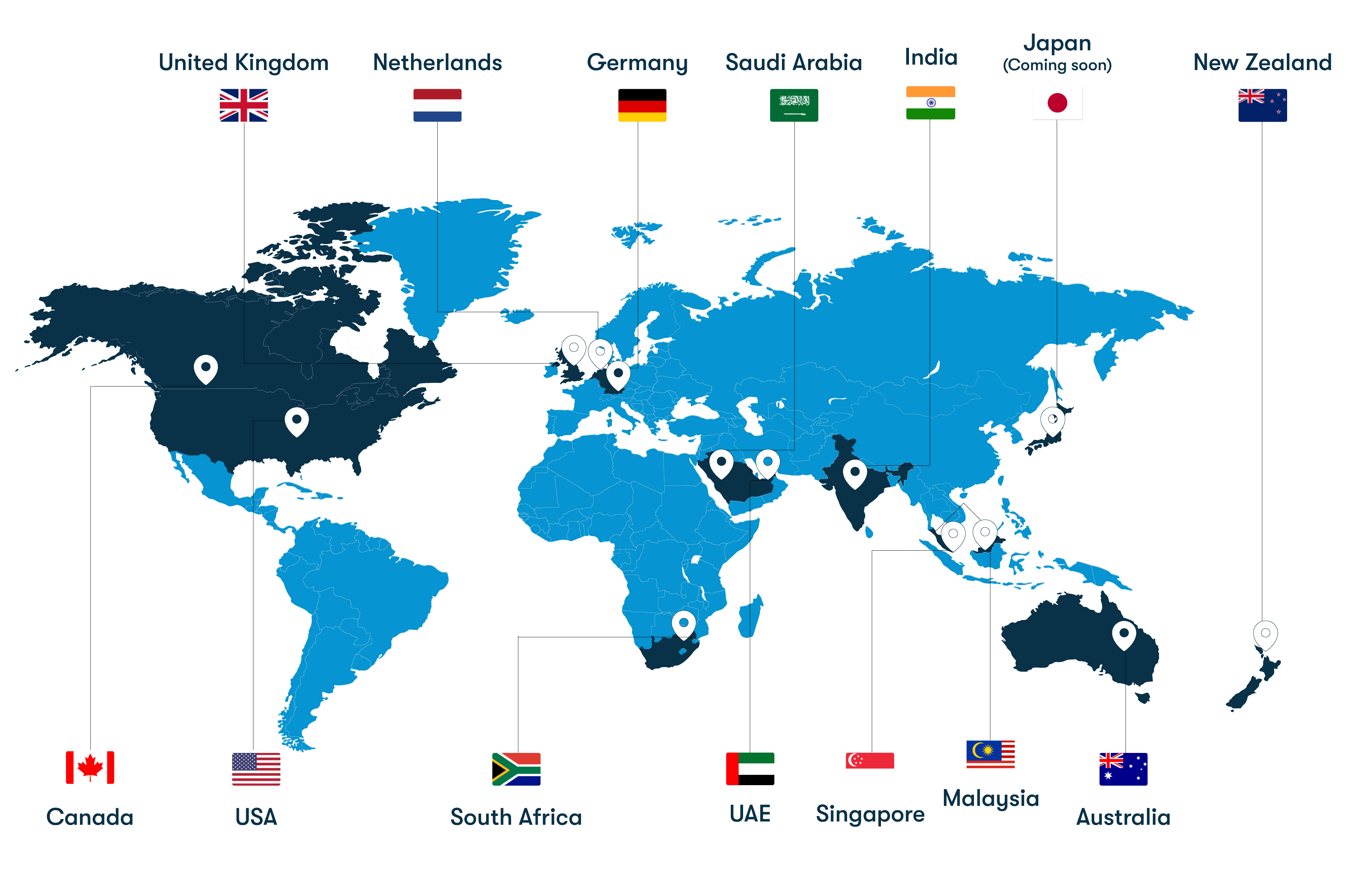
From our headquarters in India to training centers across UAE, Iraq, Saudi Arabia, UK, USA, Singapore, Australia, and more — Koenig delivers Microsoft certification training in 50+ countries.